
The Orchestra: A Bridge Between Physical and Musical Worlds
Accord dives into Muthuswami Dikshitar's Carnatic compositions, the "Nottuswaras", and the origin story of the Afghanistan National Institute of Music. Plus, news about SASO's next concert!

SASO to perform Beethoven’s Ninth Symphony in Bengaluru in November!
The South Asian Symphony Orchestra is all set to perform on 29th November in Bengaluru, at the Prestige Centre for Performing Arts.
The central piece in the repertoire is Ludwig van Beethoven’s Symphony No. 9 in D minor. A choral symphony, it was composed between 1822 and 1824, and was the last complete symphony composed by Beethoven. Over 120 musicians from around the globe, including choirs from Bengaluru and Chennai, will gather together in the city to rehearse and perform this monumental work.


SASO’s resident conductor, Alvin Arumugam, described the piece as “a call for the peoples of the world to unite in solidarity”. Indeed, this music mirrors the mission of the South Asian Symphony Foundation to build peace and understanding across borders through music.
In addition to Beethoven’s 9th, there will be music commemorating the centenary of cinematic legend Raj Kapoor, and an orchestral adaptation of a Carnatic “Nottuswara”. Save the date for the concert! It promises to be an evening of musical richness.
Peace Notes
Saturday, 29th November 2025
7 PM
Prestige Centre for Performing Arts, Bengaluru
Read on to learn more about the “Nottuswaras” and the fascinating history behind them.
Orchestral Music: A Bridge Between Worlds
What could Carnatic music and Celtic folk melodies possibly have in common with one another? These musical forms, geographically and musically so distant from one another, came together in a notable set of compositions of the 17th century, called the Nottuswaras. The very name (Western notes [nottu] and Carnatic swaras) is a tribute to the synergy of these seemingly disparate genres.
Muthuswami Dikshitar (1776-1835), one of the three composers in the legendary Trinity of Carnatic Music, composed the Nottuswaras, it is believed, to help his brother Baluswami Dikshitar master the playing of plain notes on the violin. What are “plain” notes?, you may ask. One of the characteristic features of Carnatic music is the use of gamakas in the melodies. These are ornaments that require the performer to glide seamlessly between notes, or move quickly between multiple notes surrounding the central pitch. Very much NOT “plain” notes. This is generally not stylistically present in Western melodies, as they require “straight” or “plain” notes, without gliding too much between notes.
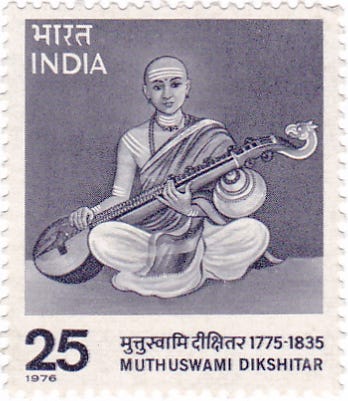
So, what are these Western melodies that found themselves adapted into songs with Sanskrit lyrics? A number of them are based on Irish or Scottish folk tunes. Dikshitar spent time at Fort St. George (Chennai) and was exposed to the British bands playing orchestral music. Likely, this was the influence behind the creation of the Nottuswaras as well as the adaptation of the violin into Carnatic music. Most of these folk tunes are in the major scale, and so the Nottuswaras are composed in raga Shankarabharanam (which contains the same notes as the major scale). The Nottuswaras make for an excellent teaching tool for early learners of Carnatic music, since they use straight notes and the raga is familiar to the ear. Listen to T. M. Krishna’s rendition of “Vande Meenakshi” below, and the Celtic folk tune “Rakes of Mallow”.
Part of the South Asian Symphony Foundation’s mission has been to bring more South Asian music into the body of orchestral works. To this effect, SASF has commissioned works like Hamsafar: A Musical Journey through South Asia (Lauren Braithwaite) and Ideas of Freedom (Anand Antonius Nazareth) for previous concerts. There are some very special commissions in the works for the upcoming concert in November too! London-based composer and orchestrator Nipun Bhatnagar is orchestrating one of the songs from the Nottuswaras collection for SASO’s upcoming concert in November. In addition, he is arranging two medleys of songs from Raj Kapoor’s films - a tribute to the cinematic legend to mark his centenary.
Nipun has composed music for numerous films and documentaries, such as Bajo El Agua (dir. Eva Wikke, 2023) and Chardi Kala - An Ode to Resilience (dir. Prateek Shekhar, 2023). He also works closely with music directors in the Indian film industry to create orchestral music and arrangements for films. He has collaborated with A. R. Rahman on several films, orchestrating music for Raayan (2024) and Maidaan (2024), among others.
The Orchestra in Indian Film Music
Nipun chatted with Accord about the historical use of the orchestra in Bollywood. Film music in the 1950s and 60s made use of a lot of orchestral music. Legendary music director Naushad Ali is the one who pioneered using orchestral layers and textures in his songs. He wove Indian folk and classical melodies in with the orchestral instruments, creating a rich and distinctive sound. One of the most notable examples of his works is the music of the film Mughal-e-Azam (1960). Below is one of Nipun’s personal favourite songs from Mughal-e-Azam - “Bekas pe Karam Kijiye”. In it, you can hear the orchestral strings effortlessly flowing alongside the tabla and sitar.
On his process of orchestrating music, Nipun said that it is much like translating between languages. A significant portion of orchestral music used in Indian films is recorded in Europe or the United States (Budapest in Hungary being one of the choice locations). It is vital to be able to convey the nuances of Indian music to the recording artists, somehow. So he often has to figure out how to notate the intricacies of, for example, a Carnatic gamaka or a Hindustani meend in a way that would allow a musician in Budapest to perform the desired effect on their instrument. “I write down the music for them in sheet music, and the intention is to produce the same-sounding music. I’m communicating with a person I’ve never met, through the sheet music, and that’s basically translation”.
The Nottuswaras, on the other hand, lend themselves to orchestration quite intuitively. Perhaps because they derive from Western folk melodies and ornamentations are minimal, the music fits in well with the abilities of the instruments in the orchestra. Nipun shared how the violin adapted well to Carnatic music because it is a fretless instrument, so sliding between notes is feasible. This isn’t the case with instruments like the clarinet or the trumpet, however. The way the instrument is constructed makes it such that gamakas could be very difficult, if not impossible, to perform.
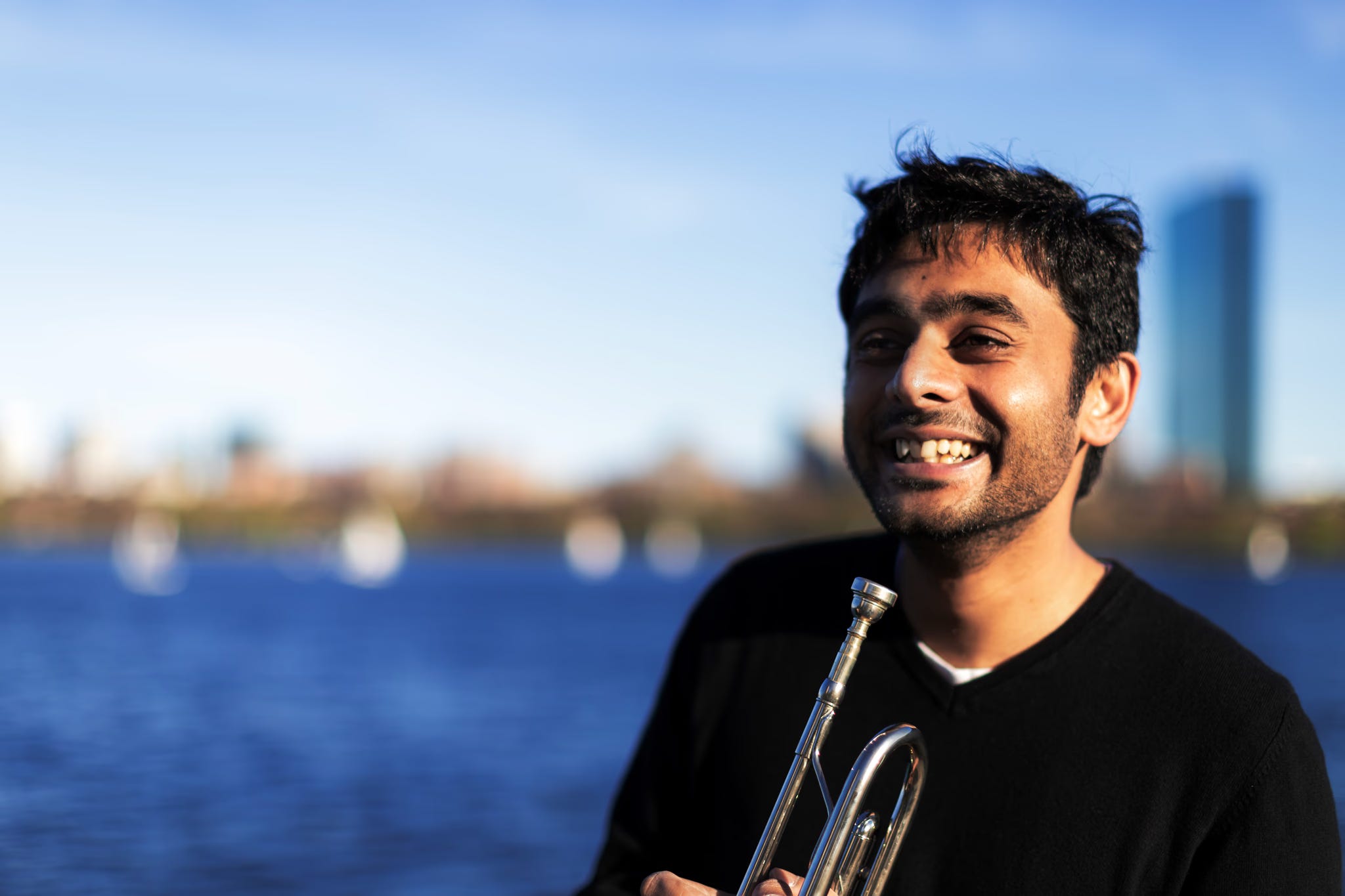
Nipun is very excited about this collaboration with the South Asian Symphony Orchestra. It is one of his long-term goals is to bring more orchestral music to India, and through these arrangements, he is doing just that. Growing up, he wasn’t exposed much to orchestral music, and it was mostly during his bachelor’s degree at Berklee College of Music, Boston, that he began to dive deeper into this multifaceted medium of music making. “It’s so great for an orchestra like SASO to exist in India because it exposes people so much more to styles of music they’re usually not listening to. It’s a great initiative”, he said.
Lives Transformed Through Music: The Origins of the Afghanistan National Institute of Music
In the previous issue of Accord, you read about the students of the Afghanistan National Institute of Music (ANIM). In this issue, we dive into the journey of Dr. Ahmad Sarmast, the Founder and Director of ANIM, and what inspired him to create the Institute.
Dr. Sarmast’s father, although a professional musician himself, never imposed music on him or any of his six siblings. Dr. Sarmast was the only one among the siblings who ultimately decided to pursue music professionally. As a young boy, his musical explorations began with the trumpet, which he studied for six years, eventually joining Radio Afghanistan as a trumpet player in an ensemble. On receiving a scholarship, he travelled to the Soviet Union to study composition and musicology. It was at this time that he began to play the piano as well. Of his early music career, Dr. Sarmast said, “At the early stages of my career as a musician, I just loved to play music. I was not aware as a teenage boy or at the beginning of my university career, I still was not aware, I did not appreciate music as a powerful tool for change. For me, music was just my love and my hobby, and who I wanted to be, but it was later, as I progressed with my education, that I learned more about the ability of music and about the power of music and how music can contribute to different aspects of life in any given society and communities.”


A major source of inspiration behind the setting up of ANIM has been Dr. Sarmast’s father’s story. When he (Dr. Sarmast’s father) was a very young child, his father passed away and his mother was not in a position to provide for four children. The decision was made to send the two boys to an orphanage, where they could get educated, and earn a living. At this time, the very first music school in Afghanistan had opened, but nobody wanted to send their children to study music. There was an unfortunate stigma related to music and musicians, and so the Minister of Defence of Afghanistan went to the orphanages to recruit students for the school. Dr. Sarmast’s father was one of the children who raised their hands, wanting to learn music. There was a lot of resistance and opposition from his mother. She even personally went to meet the Minister of Defence to ensure her son was removed from the music program. The Minister consulted the boy’s teachers and was astonished to hear from them that the boy was extremely talented. They said he would one day go on to make Afghanistan proud and therefore, he should be allowed to continue his music studies. The Minister pushed back against his mother’s decision, and he was able to pursue music further. Indeed, Ustad Salim Sarmast went on to become a famous multi-instrumentalist, composer, and conductor. His name, today, is closely associated with orchestral music in Afghanistan and contemporary Afghan music.
In 1996, the Taliban had come to power and had begun to destroy musical instruments, recordings and other related materials. Dr. Sarmast felt a calling to help preserve Afghan music for the future generations through his academic work, and he took up a PhD in Ethnomusicology at the Monash University in Australia. This, combined with the knowledge of how music had transformed his father’s life, led to the idea of having a place that would not only preserve Afghan music, but also provide a space for children from disadvantaged backgrounds to turn their lives around, through music education.


Dr. Sarmast returned to Afghanistan in 2006 as a Research Fellow of the Monash University, after many years in exile. The ROAM (Revival Of Afghan Music) project was set up to take stock of the status of music education in Afghanistan, and what could be done about it. Following this, the decision was made to revive music education through a dedicated music school, serving the most disadvantaged children of Afghanistan. Some years of research, deliberation, negotiation and hard effort led to the establishment of the Afghanistan National Institute of Music, which opened its doors to students in Kabul in 2010. ANIM has since then touched the lives of hundreds of students, providing them with a world-class music program and opportunities to perform, collaborate, and tour. The students have formed several ensembles, including the Afghan Youth Orchestra and the women’s orchestra, Zohra. Some students from ANIM have flown to India to perform with the South Asian Symphony Orchestra as well.
In 2021, when the Taliban seized control of Afghanistan once again, 273 members of the ANIM community were evacuated to Portugal. ANIM is now re-establishing itself with Portugal as its home base, and planning to work with disadvantaged children, refugees and displaced people, through the medium of music. You can read more about the students and their progress in the previous issue of Accord.
Written and edited by Aditi Bharatee