
Rehearsal to Performance: Inside the 2026 Youth Workshop and Concert
A week inside SASF's first intensive programme; and the centennial of Mario Miranda and his love of music.

The past week, 17th to 24th May, marked the South Asian Symphony Foundation’s first intensive workshop, hosted at Christ University, bringing together instrumentalists, vocalists and conductors in a programme of rehearsals and individual sessions culminating in two public performances.
Fifty participants were selected following an audition process: 21 playing orchestral instruments, 17 in the choir, 8 pianists and 4 conductors. They arrived from across the country and beyond. The majority were from Bengaluru and Chennai; others from Mumbai, Kochi, Thoothukudi, Shillong, and two from Nepal. The instrumentation reflected wider patterns in how classical training is distributed in India. The mentees comprised of strings, voice and piano, with one flute and one clarinet. It’s clear that vocal training is still the most accessible entry point into classical music.
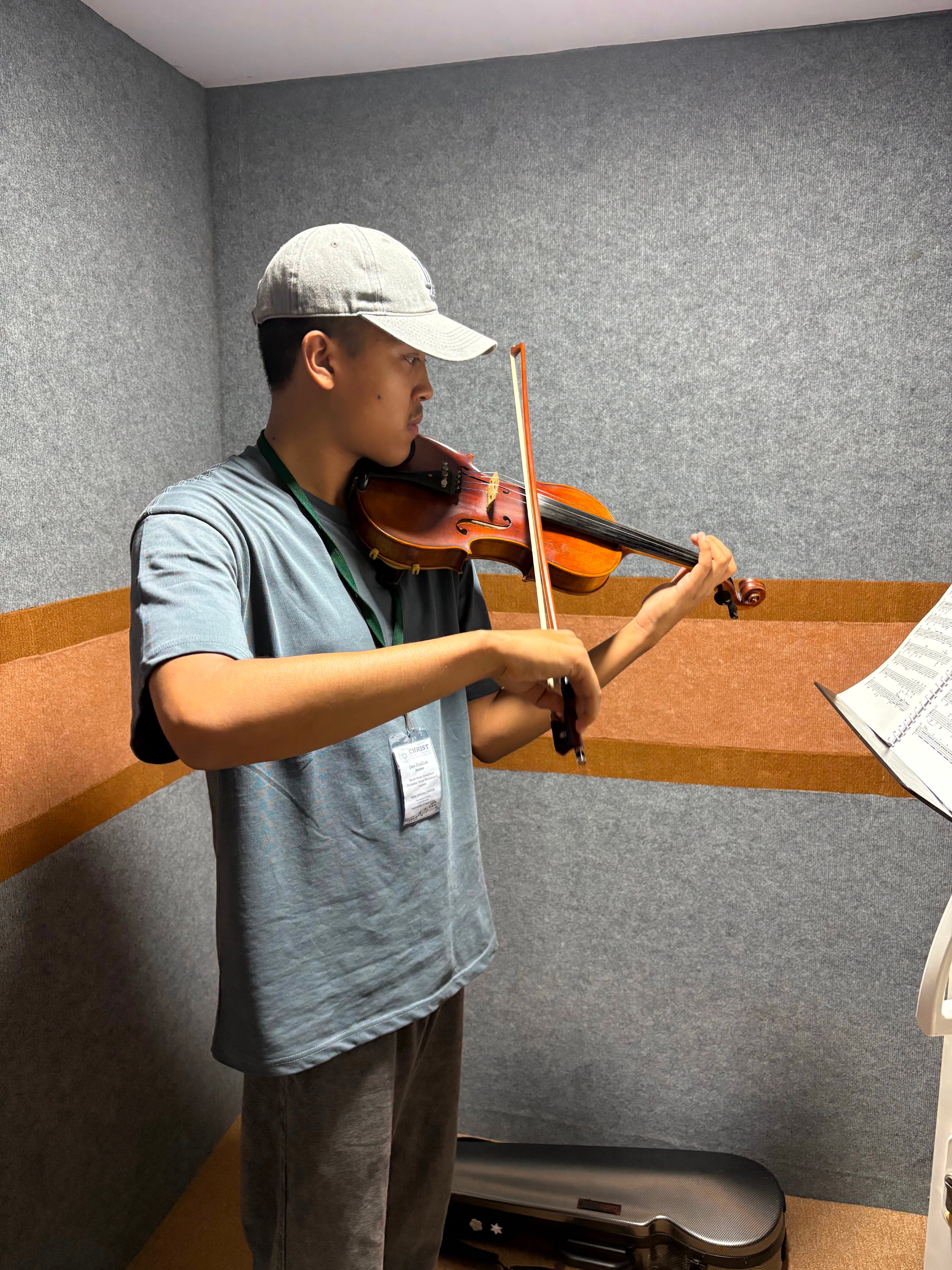
The workshop schedule ran from breakfast to evening, roughly twelve hours of structured musical activity each day. Orchestra, choir and piano sessions ran simultaneously alongside classes in musicianship and performance practice. Conductor Alvin Arumugam, speaking during the week, described the challenge of running all three streams concurrently as “massive,” and noted that future editions may separate the orchestral and choral components into more focused programmes. His approach throughout was to hold the line between support and high expectation: “My mission is to challenge them, so that after this week they leave not just having had the exposure, but also becoming better musicians.”
Participants rehearsed in ensemble settings from the first day, at the pace and to the standards of a professional musical environment. For many, this was new. Among those interviewed, one had been travelling to another city once a month for lessons; another had been studying entirely online. Some play in orchestras regularly; however full days running from morning through to evening, sustained across a week, was not something they had previously encountered. The opportunity for immersion like this is rare in India.
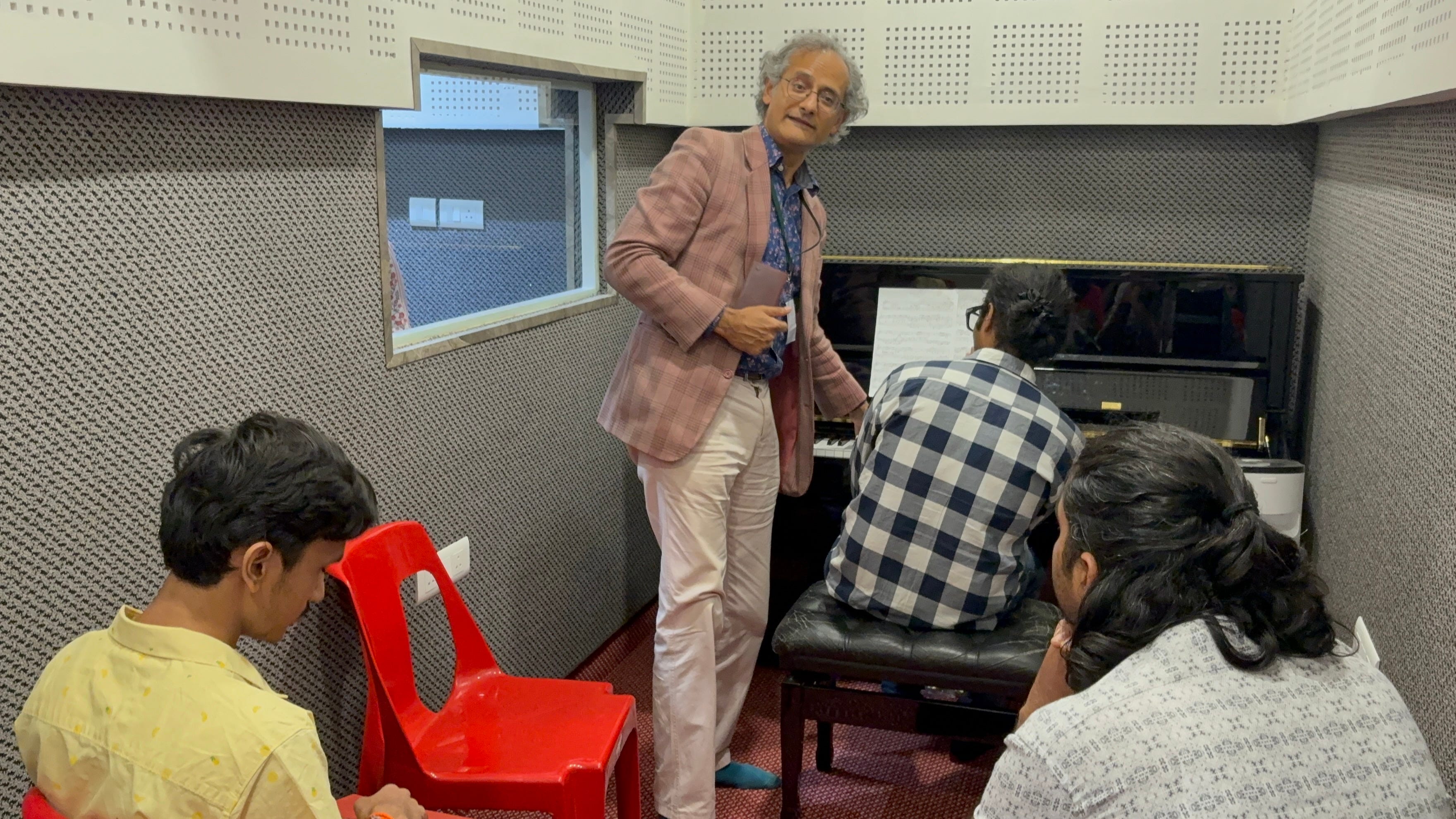
Among the faculty, Karl Lutchmayer led piano sessions throughout the week, alternating between rehearsing with the SASO orchestra for his own performance at the end of the week. A concert pianist and educator, Lutchmayer holds a PhD from Cambridge and a Master’s from Oxford, has spent fifteen years as a senior academic lecturer at Trinity Laban, and has lectured at the Juilliard School and the Manhattan School of Music. For the past five years he has served as Head of Music and Pedagogy for the Music Teachers Board in India, work for which he was awarded the Bharat Gaurav Lifetime Achievement award in 2015.
Lutchmayer’s sessions at the workshop were music conservatory level. Working through a fugue, a participant was required to examine phrasing, articulation, structure and interpretive intention in close detail, at a granularity reminiscent of professional schools.
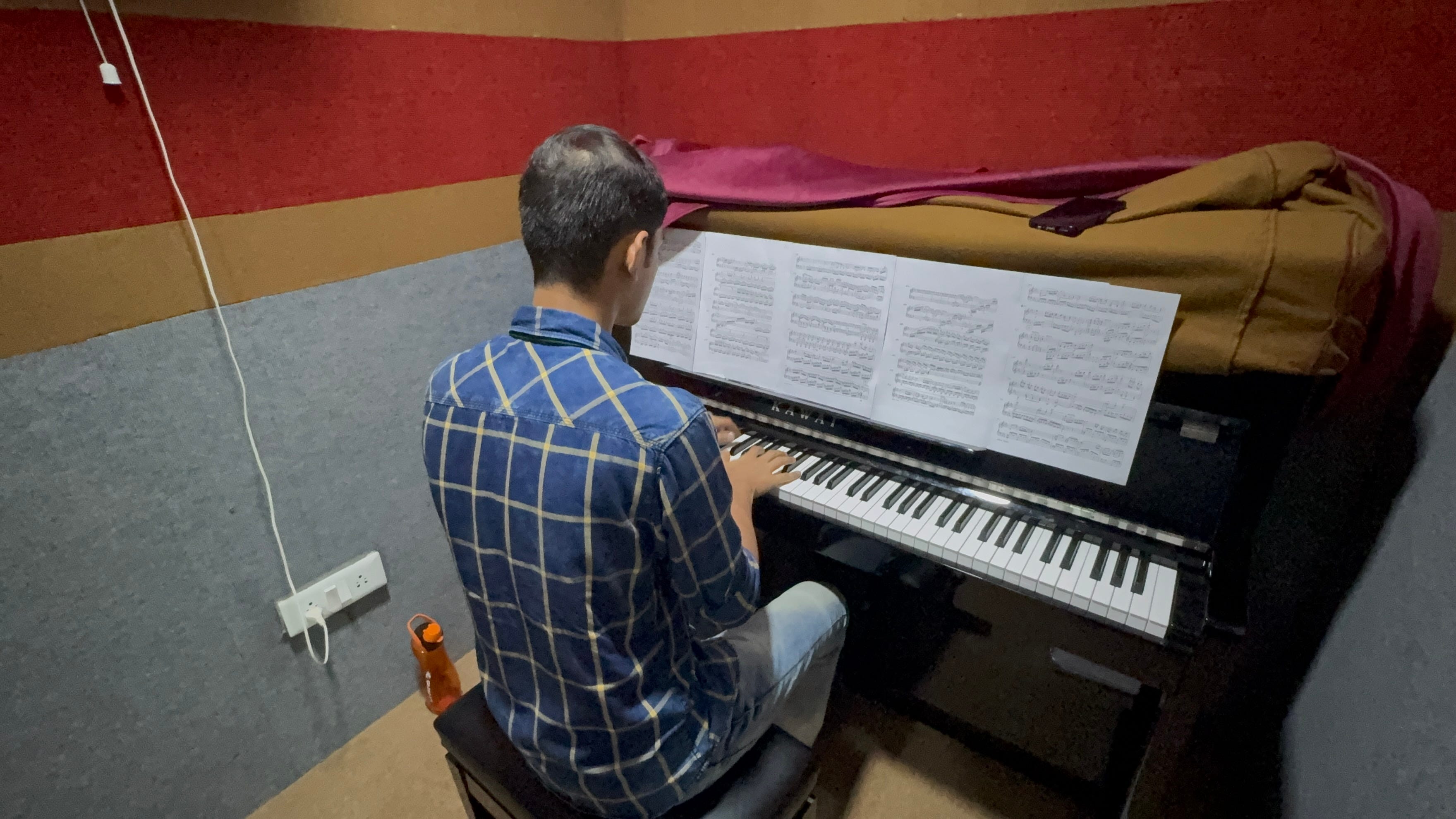
For many participants, this represented a departure from the examination-oriented systems through which they have trained. The sessions asked them to interrogate the music rather than execute it, and that distinction, between playing accurately and understanding what is actually being asked, is one that formal exams rarely make room for.
Augustine Paul directed the choral work. A Chennai-based conductor and educator, he has led the Madras Musical Association choir since 2009, taking the ensemble to London, Rome, Vienna, Poland, Singapore, Dubai and Sri Lanka. He is the founder of the Octet Cantabile and holds a Licentiate Diploma from Trinity College London alongside a Master’s in English Literature. Alvin described the effect of his rehearsals with admiration: “You walk into the room before, and you walk out after… the choir is not only better, but they’re happier.”
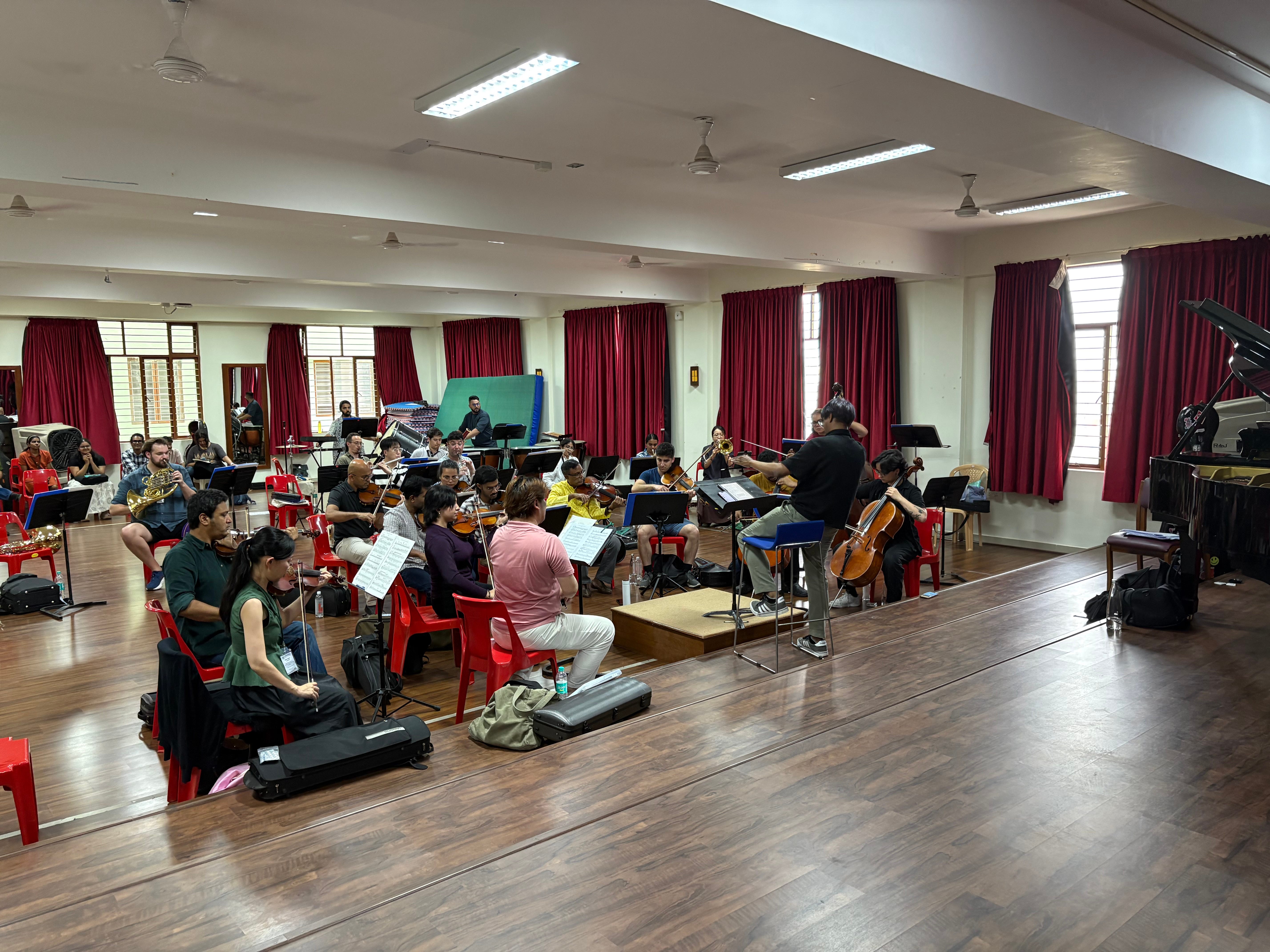
On the question of western classical music in India and whether the interest and uptake is marginal, Alvin was careful about framing this as being behind. He notes that while India is one country, it is immensely diverse culturally. It is a country of multiple languages, norms, and musical tradition that stretches back thousands of years. Western classical music is growing here, but it is doing so alongside, not instead of, what already exists.
“That is why we exist,” he said. His advice to students was to embrace curiosity. A musician needs to be curious about everything: orchestral music, opera, popular music, fine art, literature, language, history. “The instrument is a medium of the artist. The artist needs to develop the inside.” Whether participants go on to professional careers is, in his view, beside the larger point.
“We not only need professional musicians, but we need music lovers to support the growth of musicians. If out of the entire orchestra two become professionals and ninety-eight become music lovers, that is still important.”
The Weekend Concerts
The Saturday concert, at Christ University Auditorium, showcased the efforts of workshop participants and members of SASO in a programme that drew on the operatic and choral repertoire rehearsed through the week, alongside the concerto work of three pianists.
The programme opened with Beethoven’s Coriolan Overture, a short, dramatic orchestral work. The choral programme that followed moved through some of the most recognisable works in the western canon. Bruckner’s Locus Iste is a brief sacred piece. The two Mozart excerpts came from operas most audiences will know: a scene from Die Zauberflöte (The Magic Flute), and an aria from Le Nozze di Figaro (The Marriage of Figaro). Puccini’s Kyrie from his early Messa di Gloria is warmly melodic in the way Puccini always is, and Verdi’s Va, pensiero from Nabucco, a chorus of exiles yearning for home, closed the choral half.
The second half was given over to Beethoven’s Piano Concerto No. 3, with three pianist mentees performing one movement each. One of them had stated during the week that they’d begun learning their movements only two weeks before the concert. The performances were polished and exhilarating. The encore was Augustine Paul’s arrangement of Dingiri Dingale, a Tamil folk song that is becoming a SASO signature.
Sunday’s concert featured SASO with Karl Lutchmayer as soloist. The programme opened with Maithreem Bhajata, a Sanskrit Bhajan made famous by M.S. Subbulakshmi’s performance in October 1966, performed here as a prelude by Bengaluru based carnatic singer Bhargavi Venkataram.
Copland’s Appalachian Spring and Gershwin’s Rhapsody in Blue, both with Lutchmayer at the piano, formed the first half of the programme. Appalachian Spring is quiet and expansive, yet delicate. Copland wrote it as a ballet score and it has the feeling of open landscape, unhurried and clean. Rhapsody in Blue is almost the opposite: full of cinematic energy and swagger, it moves between moods quickly, blending the sound of a jazz band with a full orchestra. It is one of those pieces that announces itself immediately. The arrangement performed was sourced specifically for the occasion; as Alvin noted, the original orchestration is vast and the evening required a leaner version to fit the instrumentalists available.
“It was really tough,” he said, “but we managed to do it.”
The concert closed with Mozart’s Symphony No. 41, the “Jupiter”; the last symphony he ever wrote, and arguably his most ambitious. The final movement is remarkable for the way it weaves multiple melodies together simultaneously, which is harder to do than it sounds and even harder to make feel effortless. For the encore, Alvin returned to it: the closing passage of that same movement, performed, as he noted, “as it was done many years ago”.
The Man Who Drew Music: On the Centennial of Mario Miranda
Born in Daman on May 2 1926, Mario Miranda was known for infusing life and fluidity onto his canvas with every brushstroke. One could describe him as a cartoonist, painter, an observer of everything.
He is remembered mostly for his people: the bulgy-eyed characters jostling on Bombay footpaths, the gossiping beatas on Goan balcaos (so popular that you can get figurines of them!), the formidable Miss Fonseca and the stylish Miss Nimbu Pani. He is also known for his ability to capture the buzz and vibrance of a room full of people, whether at a concert hall or a crowded street.
For over two decades, at the Jazz Yatra festivals held at Rang Bhavan in Mumbai, one could spot Miranda in the front row, sketchpad open, drawing world-famous jazz musicians as they played. He wasn’t there as a journalist. He was there as a jazz aficionado who happened to draw. The sketches he made: pen, ink, and watercolour works, captured Herbie Mann, Kenny Barron at the piano, the whole mood of those open-air nights. These were published the very next morning in the papers, still warm from the night before.
Most artists working at the speed of daily journalism lose feeling in the rush. Miranda seemed to gain it. His Jazz Yatra drawings have an improvisational quality, a looseness you don’t always find in his more finished work. They look the way jazz sounds: structured chaos, figures leaning into something just off the edge of the frame.
Art critic Uma Nair once described his style as possessing a “collective melody and mood,” while the usual descriptions of art are in visual terms: composition, colour, line, space, form. Yet this is an apt description of his art. His compositions are alive and fluid with a sense of movement. This is less surprising when you consider where he grew up. He observed people everywhere, and in Goa, movement was everywhere and music was never just in the background.
The taverna appears repeatedly in his notebooks from his early years, alongside church processions, street scenes, the market. In these works, musicians are often part of the crowd rather than the subject; a village band tucked into a corner, someone playing while others eat and drink and argue.
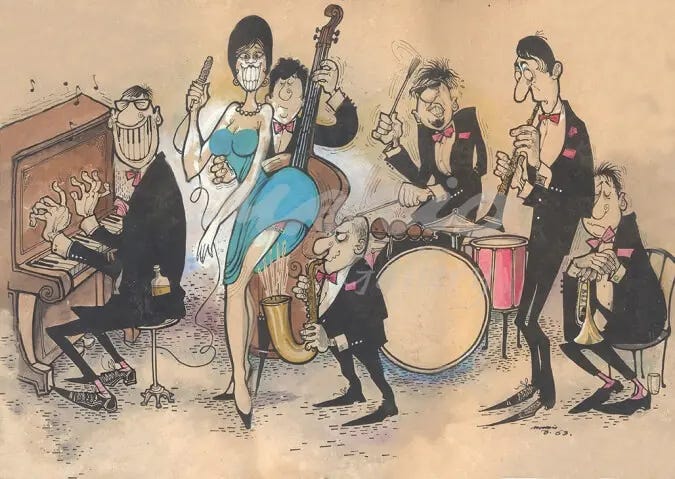
Alongside the laughter it evokes, you can almost hear the music from ‘The Jazz Band’, a cartoon that captures the spirit of every other modern musician we encounter today.
The ‘Local Musician’ captures the hilarity of a life making music away from the stage. Mild irritation, yet no time for pause, the show going on regardless.


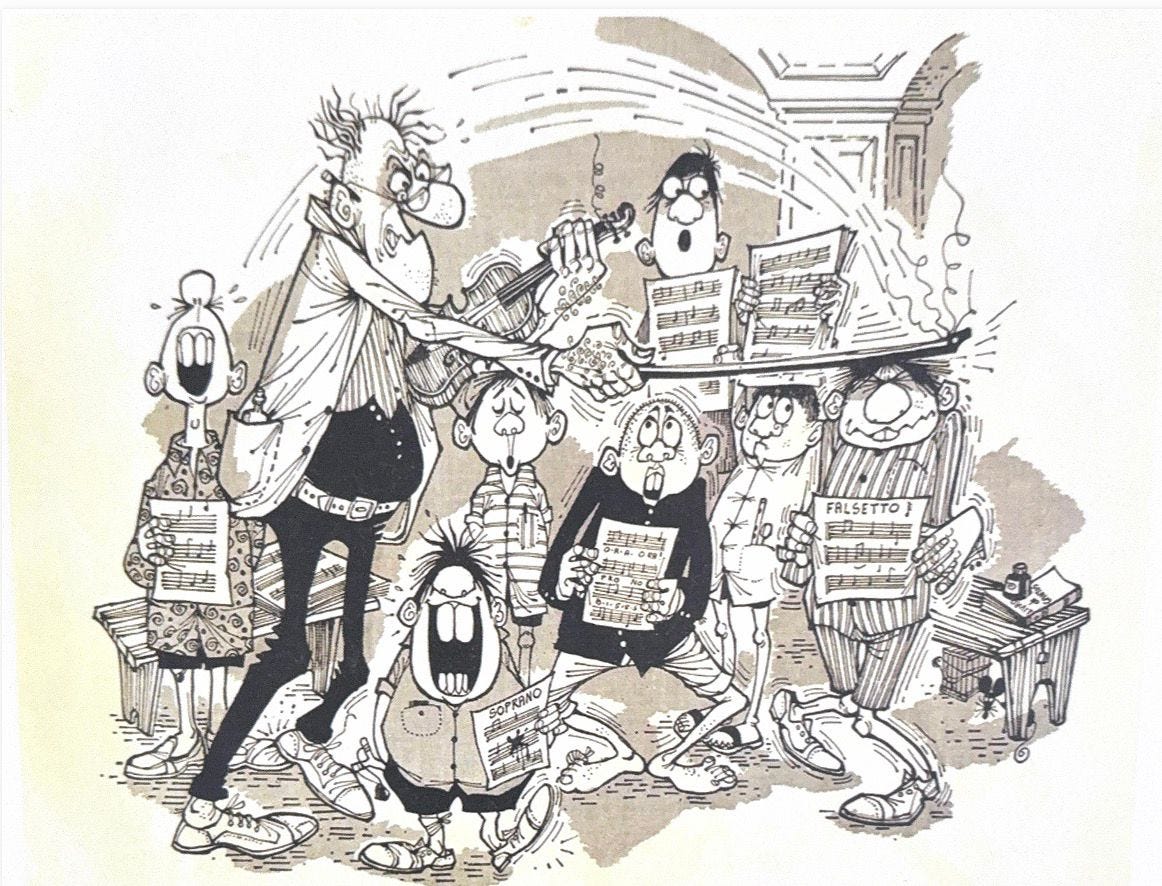
‘Choir Master’ is a masterful scribble of a frantic choir gathering themselves under the baton of an exasperated choir director. There’s a density to the detail that captures the viewer’s attention; from the bottle in the choir director’s pocket to the mouse under the side table. There was no detail to be missed.
Two nights before he died, Miranda was at a musical evening at a nearby restaurant. He was 85, and his final years were spent doing what he typically did. Enjoying good food and music, with a touch of the vibrancy from his cartoons.
Written and edited by Ankrita Shankar